
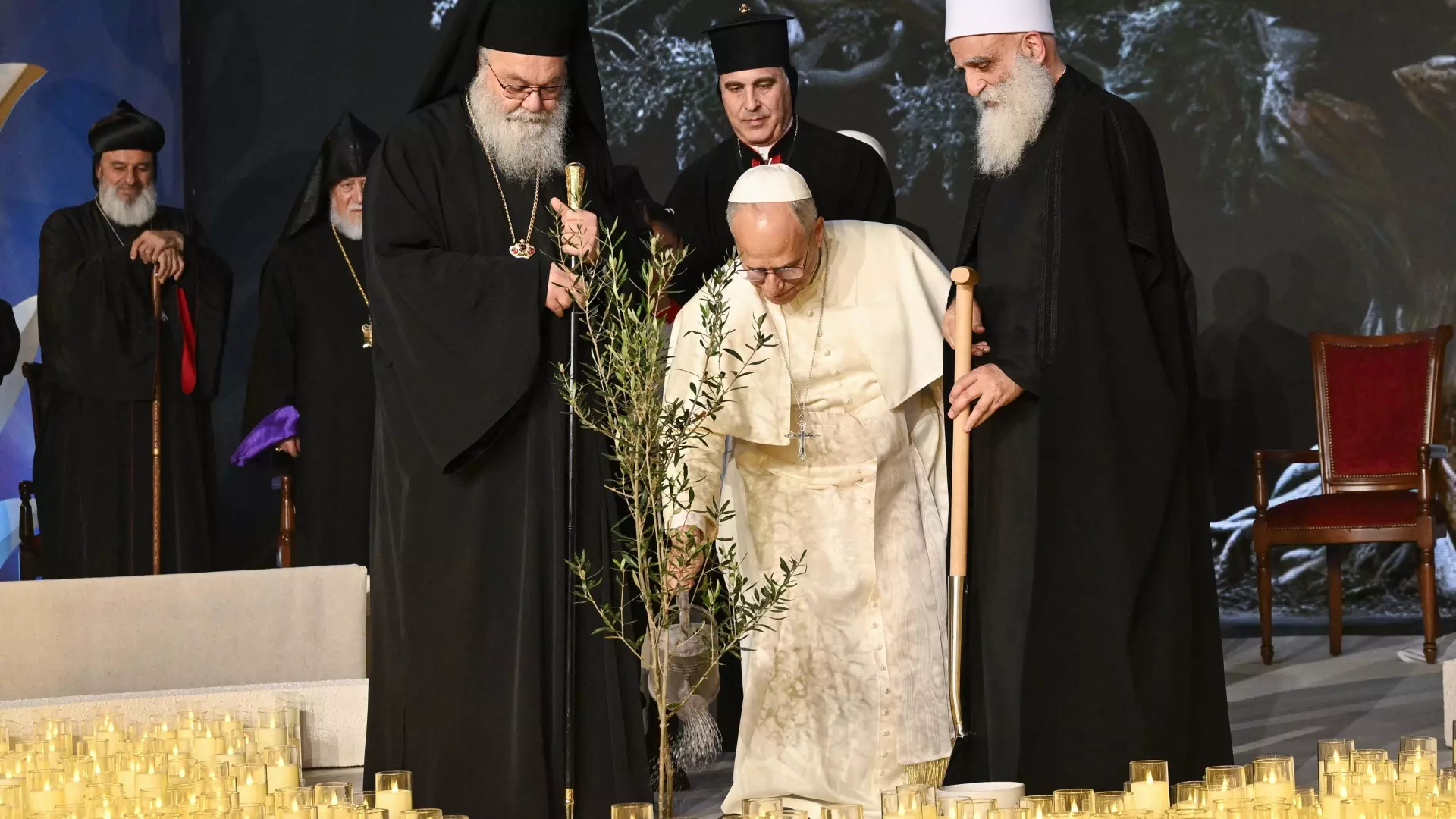
Pope Leo XIV during an ecumenical and interreligious gathering in Beirut, December 1, 2025.
Where Is the Schism?
March 24, 2026
Source: FSSPX News
The following piece is by Fr. Jean-Michel Gleize, SSPX.
The schism does indeed exist. But it is not where some believe they see it.
The announcement of the episcopal consecrations, scheduled for this coming July 1st, has left no one indifferent. This is all the more true given that the letter addressed to Cardinal Fernandez on February 18th by the Superior General of the Society has, to date, met with absolutely no response from Rome. Faced with this silence from Rome, bishops are speaking out: some to condemn the initiative regarding the consecrations, others to justify and defend it against the criticisms it has incurred.
The remarks of Bishop Schneider are by now well known. Received in audience on December 18, 2025, by Pope Leo XIV, the Auxiliary Bishop of Astana had already pleaded the cause of the Society of Saint Pius X 1. Subsequently, in an interview granted on February 17th to journalist Robert Moynihan 2, Bishop Schneider quite firmly took issue with the remarks made by Cardinal Fernandez to the Superior General of the Society of Saint Pius X during their meeting on February 12th, remarks that were made public, and through which the Prefect of the Dicastery for the Doctrine of the Faith sought to impose upon the Society the resumption of a dialogue that could already be foreseen as leading nowhere, and whose only tangible effect would be to postpone the date of the episcopal consecrations sine die, to the great detriment of the salvation of souls. On February 24, Bishop Schneider made public a “Fraternal Appeal Addressed to Pope Leo XIV”3: “The Holy See,” he declared, “should be grateful to the SSPX, because it is currently almost the only major ecclesiastical reality that forthrightly and publicly points out the existence of ambiguous and misleading elements in certain statements of the Council and in the Novus Ordo Missae. In this endeavor, the SSPX is guided by a sincere love for the Church: if they did not love the Church, the Pope, and souls, they would not undertake this work, nor would they engage in dialogue with the Roman authorities—and they would undoubtedly have an easier life.” He concluded that the Pope should unconditionally grant the apostolic mandate for the episcopal consecrations scheduled for July 1, 2026. Finally, on March 9, in a lengthy interview granted to journalist Andreas Wailzer on the YouTube channel Kontrapunkt 4, Bishop Schneider stated unequivocally that the episcopal consecrations would not be schismatic, as they constitute the necessary and legitimate reaction, demanded by the salvation of souls, on the part of the Society of Saint Pius X.
For his part, Msgr. Strickland, Bishop Emeritus of Tyler, had already distinguished himself through his emphatic praise of Archbishop Lefebvre and the November 21, 1974 Declaration.5 Not content with merely acknowledging the state of necessity within the Church and justifying the stance of the Society of Saint Pius X, the American prelate went so far as to legitimize the future episcopal consecrations announced by Fr. Davide Pagliarani. 6
Both of these prelates acknowledge the state of grave necessity that has prevailed within the Church since Vatican II. And, remarkably, both also trace this situation back to its root causes. According to them, the widespread crisis affecting the entire Church cannot be explained merely by simple abuses, abuses supposedly stemming from a poor implementation of the reforms undertaken by the Council, or from developments dependent upon it. Rather, the crisis, first and foremost, finds its true explanation in those very reforms, in the new social doctrine based on the false principle of religious liberty, in the new ecumenist ecclesiology; in the collegialist and synodalizing conception of Church governance, and in the new, Protestantized liturgy. Thus, both prelates fully vindicate the work undertaken by Archbishop Lefebvre to ensure the survival of the Church through the preservation of her priesthood, specifically, the survival of the Church’s unity, in the face of all those forces of dissolution that threaten it ever more acutely.
For his part—and following in the footsteps of Cardinal Sarah, Msgr. Eleganiti has recently spoken out 7 to denounce what he terms “a schismatic mindset and behavior” regarding the intention to carry out the episcopal consecrations scheduled for this coming July 1st. His statement effectively serves as a repudiation of the position taken by Bishop Schneider. Yet, despite being just as critical as the latter regarding the reforms stemming from the Second Vatican Council 8, the former Auxiliary Bishop of Chur recoils from taking the exceptional measures necessary to ensure the survival of the Church, in both her faith and her morals, in the face of a widespread corruption of doctrine and morality.
But where is the schism? “According to Canon 1325, §2, of the 1917 Code of Canon Law,” explains canon law specialist Raoul Naz 9, schism impairs the unity of the Church “because it presupposes a systematic and habitual refusal of dependence. Conversely, disobedience may be merely a fleeting act, without its perpetrator in any way challenging the authority of the law or the legislator, or seeking to habitually exempt himself from it.” Now, it is clear and well-established that neither Archbishop Lefebvre nor his successors at the head of the Society ever intended to separate themselves from the unity of the Church, for they never sought to reject the very principle of dependence upon Rome. If the Society is schismatic, then why all these contacts between the Society and the Vatican, with Rome? Why, following the election of Leo XIV, did the Superior General of the Society write to the pope requesting a meeting?
Thus, not only did the Society never intend to separate itself from the unity of the Church, in its intention, but furthermore, independently of this good intention, the very act of episcopal consecration, taken in itself, and even though it was performed ostensibly against the will of Rome, does not constitute a schism. A schism exists only if the bishop consecrating other bishops presumes to confer upon them the authority to govern, for that is something only the pope can do. To consecrate bishops, even against the pope’s will, without conferring jurisdiction upon them is not to commit schism, for it does not constitute a rejection, in principle, of the pope’s power, which is the source of all jurisdiction. Msgr. Eleganti is conflating everything.
Schism does indeed exist. But it is not to be found where Msgr. Eleganti imagines he sees it. And yet, it where he fails to see it. The schism is that shameless ecumenism pursued with appalling obstinacy by Pope Leo XIV. For what truly and gravely undermines the unity of the Church is not the consecrations at Ecône; it is ecumenism; it is interreligious dialogue. Because, taken in themselves, these initiatives all presuppose that dependence upon God does not necessarily entail dependence upon the Vicar of Christ—the pope.
Last December, during his visit to Lebanon, Pope Leo XIV addressed both Catholic Christians and Muslims, stating: “Your presence here today, in this remarkable place where minarets and church steeples stand side by side, yet both rise toward the heavens, bears witness to the unwavering faith of this land and the unfailing devotion of its people to the One God. Here, in this beloved land, may every peal of a bell, every adhan, every call to prayer blend together and rise as a single hymn, not only to glorify the merciful Creator of heaven and earth, but also to offer a heartfelt prayer for the divine gift of peace.” Where, then, is the schism?
-
https://fsspx.news/en/news/bishop-schneider-reveals-details-his-audience-leo-xiv-57390 ↩︎
-
https://fsspx.news/en/news/rome-and-sspx-bishop-schneider-responds-cardinal-fernandez-57406 ↩︎
-
https://fsspx.news/en/news/bishop-schneider-appeals-pope-leo-xiv-build-bridge-between-rome-and-sspx-57437 ↩︎
-
https://fsspx.news/en/news/bishop-schneider-episcopal-consecrations-sspx-will-no-way-be-schismatic-57822 ↩︎
-
https://fsspx.news/en/news/bishop-strickland-lauds-archbishop-lefebvre-49411 ↩︎
-
https://fsspx.news/fr/news/une-lettre-mgr-strickland-57460 ↩︎
-
https://lesalonbeige.fr/fsspx-mgr-eleganti-conteste-linterpretation-de-mgr-schneider/ ↩︎
-
https://fsspx.news/en/news/bishop-eleganti-strongly-criticizes-vatican-ii-and-new-liturgy-54923 https://fsspx.news/en/news/bishop-eleganti-vatican-ii-or-promised-springtime-never-happened-56019 ↩︎
-
Raoul Naz (1889–1977) is the undisputed specialist in Canon Law of the twentieth century, author of the classic Dictionnaire de droit canonique [Dictionary of Canon Law] (Letouzey et Ané, 1965); the seventh volume of this work (col. 886 et seq.) contains the entry on “Schism,” from which we have extracted these observations.
(Sources : La Porte Latine - FSSPX Actualités)
Illustration : Abaca Press/ID 3D8M6RN-Banque d’images Alamy ↩︎